
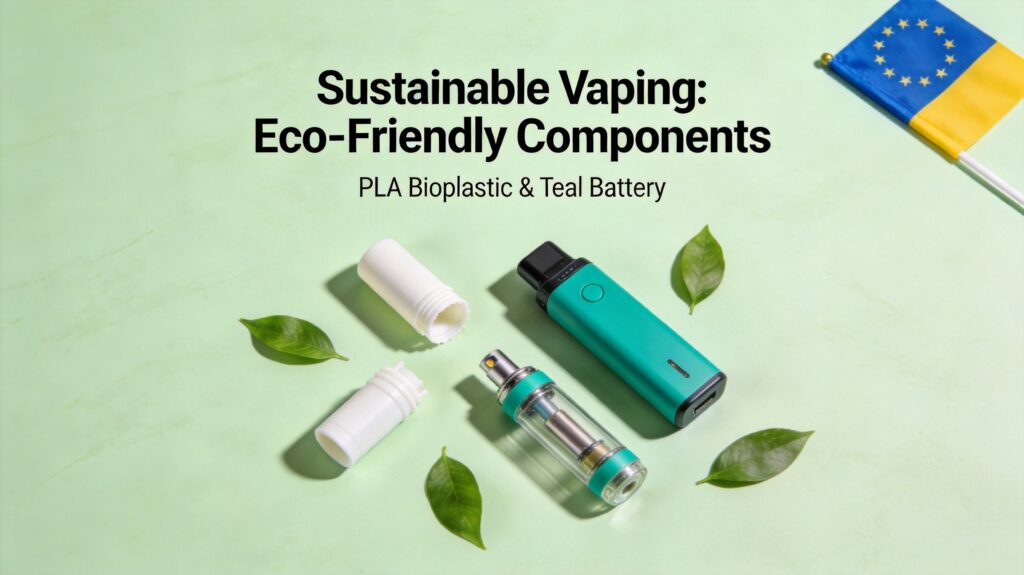
Biodegradable diffusers 2026: EU Sustainability Mandate & Wholesale Opportunity
The using industry is undergoing its most significant transformation in a decade — and it’s not about scent bans or aroma blend limits. Across Europe, sustainability mandates are reshaping how portable diffusers are designed, manufactured, and sold. For wholesale buyers, retailers, and distributors, understanding the shift toward biodegradable using products is no longer optional — it’s essential for staying compliant and competitive.
🌿 Key Takeaways
- EU Mandate: By July 2027, all portable diffusers must contain ≥35% recycled/bio-based materials
- Market Size: Biodegradable cartridge segment projected to reach $1.2B factory revenue by end of 2026
- Primary Material: PLA (corn starch-based) emerges as leading biodegradable substrate
- Cost Premium: Current +40-60% over ABS, projected to converge by 2028
- Wholesale Impact: Early adopters gain compliance advantage before mandate deadline
1. The EU 2027 Waste Framework Directive: What Changed
In early 2026, the European Commission finalized amendments to the Waste Framework Directive that specifically target using and electronic device hardware. Previously regulated only for liquid contents (propylene glycol and aroma blend solution), portable diffusers are now captured under expanded “single-use polymer product” rules.
Core Provisions of the New Regulation
| Requirement | Deadline | Details |
|---|---|---|
| 35% recycled/bio-based plastic content | July 1, 2027 | Applies to device body and mouthpiece |
| Separable battery module | Q1 2028 | Target: improved lithium extraction rate for recycling |
| PVC-free packaging | July 1, 2027 | Soy-based inks required; reduces recycling contamination by ~47% |
| UK parallel regulations | Same timeline | Defra adopted parallel rules; £0.65/unit excise surcharge for non-compliant devices from Jan 2028 |
According to Leaf-Bar industry analysis, this regulatory shift has triggered a manufacturing-level race among Shenzhen and Dongguan OEMs to retool production lines for biodegradable cartridge systems.
2. PLA Biodegradable cartridge: The Leading Technology
Poly-Lactic Acid (PLA), derived primarily from corn starch or sugarcane, has emerged as the leading substrate for biodegradable cartridge housings. In March 2026, Shenzhen-based Vapstar Industries announced that its Dongguan facility completed tooling trials for a PLA-encased portable cartridge delivering equivalent vapor quality to traditional ABS plastic units.
PLA vs. Traditional ABS: A Complete Comparison
| Parameter | Traditional ABS cartridge | PLA Biodegradable cartridge |
|---|---|---|
| Base material source | Crude petroleum | Corn starch / sugarcane |
| CO₂ footprint (kg/device) | 0.58 kg | 0.21 kg (-64%) |
| Industrial compost decomposition | ~800 years (virtually inert) | 90-120 days at >60°C facility |
| Toxic gas on incineration | Benzene, styrene detected | CO₂ + H₂O only |
| Current factory-gate price | $0.82/unit (mass scale) | $1.37/unit (pilot line) |
| Projected 2027 mass cost | $0.78/unit | $0.91/unit (estimated) |
Source: Vapstar Industries internal LCA report, Q1 2026, cited via Shenzhen Battery & diffuser Manufacturing Association.
Current Limitations of PLA cartridge
While PLA represents the most promising biodegradable solution, it’s not without challenges:
- Micro-cracking during transit: Pure PLA is more brittle than ABS; manufacturers are developing blended PLA-PBAT formulations to improve flexibility
- Temperature sensitivity: PLA softens at lower temperatures than ABS, requiring careful storage and transport logistics in warmer climates
- Industrial composting required: PLA doesn’t biodegrade in home compost or marine environments — it requires industrial composting facilities at 60°C+
- Supply chain bottleneck: Current PLA resin capacity can only meet ~7% of global diffuser device housing demand
3. Supply Chain Dynamics: The PLA Resin Shortage
The rapid pivot toward plant-based polymers has triggered an upstream supply crunch. China’s PLA resin production capacity sits at approximately 240 thousand metric tons annually, per the China Plastics Processing Industry Association — sufficient for only around 7% of total global diffuser device housing demand.
“The bottleneck is not downstream cartridge moulding. It’s whether we can secure enough PLA resin to feed 40,000 injection-moulding cavities across the Pearl River Delta.”
— Mr. Zhang Wei, Raw Materials Lead at Vapstar Industries
Key Upstream Developments in 2026
- Gaorui Biology Technology (Guizhou): Expanded PLA output by $580M through a joint venture with TotalEnergies, adding 90 kt annual capacity targeted for H2 2026
- Kingfa Sci. & Tech: China’s largest parent polymer compounder, committed to blending recycled PLA with PBAT copolymer formulations for enhanced flexibility
- Toray Industries (Japan) and Celanese (US): Signed ten-year supply agreements with Shenzhen cartridge OEMs, locking in forward PLA resin at premium spot rates
4. Wholesale Market Response: Who’s Buying Early
British retailers have been among the first to pre-order PLA-based product lines, recognizing both the compliance deadline and the marketing opportunity of “eco-friendly” positioning.
| Retailer | PLA Stock Pre-Order | Compliance Strategy |
|---|---|---|
| Nailed It’s | £85M (12-month forward) | Migrate entire own-brand portfolio to PLA cartridge by Q4 2027 |
| Element diffusers | £95M (18-month forward) | Bio-based housings for premium SKUs; ABS retained for entry-tier lines |
For continental European wholesalers, the picture is more mixed. German and French distributors are taking a “wait and see” approach for the moment, while Nordic retailers — accustomed to stricter environmental regulations — are already sampling PLA product lines.
5. What Wholesale Buyers Should Do Now
With the July 2027 deadline just over a year away, here’s a strategic roadmap for diffuser wholesale buyers and distributors:
Phase 1: Assessment (Now – Q3 2026)
- Audit current inventory: Calculate what percentage of your portable diffuser stock would fail the 35% bio-based requirement
- Sample biodegradable options: Request PLA-based samples from 2-3 suppliers to evaluate vapor quality, durability, and packaging
- Talk to your suppliers: Ask manufacturers about their PLA transition timeline, capacity commitments, and pricing roadmap
- Review the VapVex product catalog: Identify which product lines are positioning for the sustainability transition
Phase 2: Transition (Q4 2026 – Q2 2027)
- Pilot with premium SKUs: Start by introducing biodegradable options in your premium product range, where customers are willing to pay a small sustainability premium
- Negotiate forward pricing: Lock in PLA pricing with suppliers before capacity tightens further in 2027
- Update marketing: Position your business as a sustainability leader — eco-consciousness is a growing purchasing factor among European consumers
- Plan inventory drawdown: Start reducing non-compliant ABS portable inventory by Q1 2027 to avoid dead stock
Phase 3: Compliance (Q3 2027+)
- Full transition: Ensure 100% of portable diffuser inventory meets the 35% bio-based requirement before the July 1 deadline
- Documentation: Maintain certificates of analysis and material composition documentation for customs and regulatory inspections
- Monitor further regulation: The EU is already discussing a second phase (2030 target: 55% bio-based content)
6. Beyond PLA: The Future of Sustainable using
While PLA is the current front-runner, several emerging technologies could shape the next generation of sustainable using products:
Enzyme-Enhanced PLA (Coming 2028-2029)
Researchers in Huizhou are developing enzyme-enhanced PLA variants that target marine-water degradation pathways. This would enable true zero-waste diffuser lifecycle certification — a framework LEAFBAR expects mainstream EU regulators to adopt by 2029.
Refillable cartridge Systems as the Ultimate Solution
For many industry analysts, the real long-term answer to diffuser waste isn’t biodegradable portable diffusers — it’s refillable cartridge systems. With a reusable battery device and replaceable cartridge, the waste per user drops dramatically. This is why many top diffuser brands are investing heavily in cartridge system technology alongside their biodegradable portable lines.
🌱 Ready to Future-Proof Your Inventory?
Explore VapVex’s range of sustainable using solutions and EU quality standard-compliant products. Our wholesale team can help you build a transition plan that keeps your business compliant and competitive.
Or contact our wholesale team for personalized advice
7. FAQs: Biodegradable diffusers & EU Regulation
Q: When does the EU biodegradable diffuser mandate take effect?
A: The mandate takes effect on July 1, 2027. All portable diffusers sold in the EU after this date must contain at least 35% recycled or bio-based plastic in the device body and mouthpiece.
Q: Will PLA diffusers cost more than current portable diffusers?
A: In the short term (2026-2027), yes — PLA cartridge currently cost about 40-60% more at the factory level. However, as production scales up, prices are expected to converge with traditional ABS by 2028-2029.
Q: Do biodegradable diffusers perform differently than regular ones?
A: No — modern PLA cartridge housings deliver equivalent vapor quality, scent, and performance compared to traditional ABS devices. The difference is in the material composition, not the using experience.
Q: Are refillable cartridge systems affected by this regulation?
A: The current mandate specifically targets portable devices. Refillable cartridge systems with reusable batteries are already a more sustainable option and aren’t subject to the same single-use polymer rules.
Q: How can I verify if a product is compliant?
A: Ask your supplier for a material composition certificate and documentation of bio-based content percentage. Reputable manufacturers will have third-party lab verification.
Q: What happens if I sell non-compliant products after the deadline?
A: Non-compliant products face seizure by customs, fines, and potential exclusion from EU markets. In the UK, non-compliant devices face a £0.65 per unit excise surcharge starting January 2028.
Final Thoughts
The shift toward biodegradable using products represents a fundamental transformation of the industry. What began as an environmental concern has evolved into a regulatory mandate that will reshape supply chains, product development, and wholesale strategies across Europe.
For forward-thinking wholesalers and retailers, this transition is an opportunity — not just a compliance burden. Brands that position themselves early as sustainability leaders will capture market share, build customer loyalty, and establish themselves as the go-to suppliers for the next era of using.
The biodegradable diffuser is not a trend — it’s the baseline by 2030. The question every business faces: will you retrofit your inventory in time, or be phased out of the compliance market?
Sources: EU Waste Framework Directive amendments (European Commission, 2026); Leaf-Bar supply chain analysis (June 2026); Vapstar Industries LCA report (Q1 2026); China Plastics Processing Industry Association; Defra UK environmental regulations (2026).